Choosing the manufacturing partner decides whether your sun care brand grows or stalls. A weak partner delivers SPF values, unstable creams and late shipments. A strong partner protects your reputation with every batch. This guide explains how sunscreen is made, which tests matter and how to pick the partner, in India.
What Does a Sunscreen Manufacturer Do?
A sunscreen manufacturer makes, creates and packages sun protection products for brands. Some also provide label sunscreen, which means you can sell a finished formula using your own brand name. Others do contract manufacturing, where they make your approved formula exactly as you need it.
In both cases you avoid the cost of setting up a factory, a lab or hiring a technical team. That lets you focus on building your brand and growing your sales.
Types of Sunscreen You Can Launch
Pick a format that matches your customer’s skin and habits. Humid climates favour light gels, while dry climates favour richer creams.
| Format | Best For | Key Benefit |
|---|---|---|
| Gel | Oily and acne-prone skin | Light, matte, non-greasy |
| Cream | Dry and normal skin | Adds moisture |
| Lotion | Daily body use | Spreads easily |
| Mineral | Sensitive skin and kids | Gentle on skin |
| Tinted | Daily wear | Reduces white cast |
Many brands also add actives such as niacinamide and vitamin C. These ingredients turn a basic sunscreen into a multi-benefit skincare product.
Sunscreen Manufacturing Process: Step by Step
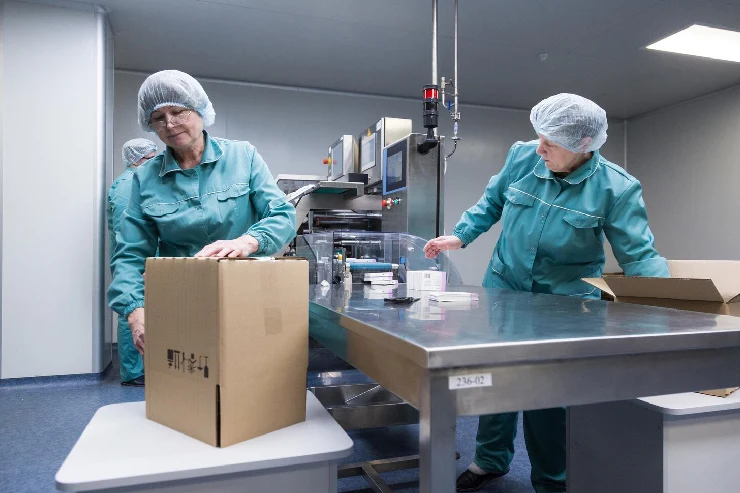
The sunscreen manufacturing process needs precision at every stage. Here is how a professional facility works:
- Brief and formulation: Chemists create the sunscreen recipe to match your desired SPF, skin type and texture.
- Ingredient sourcing: The team picks UV filters, emollients, emulsifiers and preservatives for the sunscreen.
- Emulsification and blending: High-shear mixers spread UV filters to keep the sunscreen SPF consistent.
- Quality checks: Technicians test viscosity, pH, appearance and microbial safety of the sunscreen.
- Packing: Machines fill tubes, bottles or pumps. Apply labels to the sunscreen.
- Dispatch: The factory ships batches with records, for traceability of the sunscreen.
Skipping or rushing any step risks SPF performance. Ask every manufacturer to walk you through this flow.
Chemical vs Mineral UV Filters
Chemical filters, like avobenzone absorb UV rays. Turn them into heat. Chemical filters feel light and blend clear to the eye. Mineral filters, like zinc oxide and titanium dioxide sit on the skin. Bounce back UV rays. Mineral filters are good for skin and for children.
A good manufacturer will explain both filters and mineral filters and recommend the best one, for your market. Some brands mix both filters and mineral filters in a hybrid formula.
Get QuoteSPF Testing and Quality Standards
SPF testing shows that your product gives the protection that is written on the label. False claims break customer trust quickly so consider testing as something that cannot be avoided.
Trusted manufacturers use established methods:
- Testing SPF on volunteers in real life (ISO 24444)
- Testing UVA protection in the laboratory (ISO 24443)
- Testing how well the product resists water for sports and beach items
- Testing how the product holds up under heat and light
- Testing how well the preservatives work to keep the product safe from microbes
- Ask for written reports for every test. If a supplier is not able to provide them find another supplier.
The same quality in every batch is just as important, as the test. Ask how the factory checks each batch and keeps samples for later. Good records help you find out which batch caused a problem in a few minutes.
Private Label vs Contract Manufacturing
| Factor | Private Label | Contract Manufacturing |
|---|---|---|
| Formula | Ready-made, rebranded | Your own formula |
| Launch speed | Fast | Moderate |
| Best for | Startups and distributors | Established brands |
| Customisation | Packaging and branding | Full control |
Startups often start with label sunscreen to check how the market reacts fast. Established companies usually switch to custom formulas after some time.
Contract sunscreen manufacturing works well for brands that already have a formula or a product made with a dermatologist. Your manufacturer takes that formula. Makes it bigger keeps each batch the same and keeps your ideas safe. Many companies use both options: made formulas for fast launches and contract sunscreen manufacturing, for their main products.
How to Choose the Right Sunscreen Manufacturer
Use this checklist before you sign:
- Certifications: Make sure the company holds GMP and ISO certifications. The checklist for certifications is essential.
- SPF test reports: Ask for proof on every product. The checklist for SPF test reports must be visible.
- R&D strength: Check if the team can build custom formulas. The checklist for R&D strength is important.
- MOQ: Confirm the minimum order fits your budget. The checklist for MOQ should be clear.
- Packaging range: Compare tubes, bottles and airless pumps. The checklist for packaging range helps you decide.
- support: Verify help with licences and labelling. The checklist for support is vital.
- Delivery record: Ask for references and past timelines. The checklist for delivery record shows reliability.
Always visit the facility. Request a virtual tour. A transparent partner welcomes this. Also request a sample batch before an order and test texture, scent, white cast and stability, over several weeks.
Sunscreen Regulations in India
Cosmetics in India fall under the Drugs and Cosmetics Act, and the Central Drugs Standard Control Organisation (CDSCO) oversees compliance. Labels must carry accurate SPF claims, ingredients and usage directions. Rules change, so check current requirements on the CDSCO website before launch. For export markets, read the guidance from regulators such as the US FDA.
Why Choose Jack Cosmetic Pvt. Ltd.?
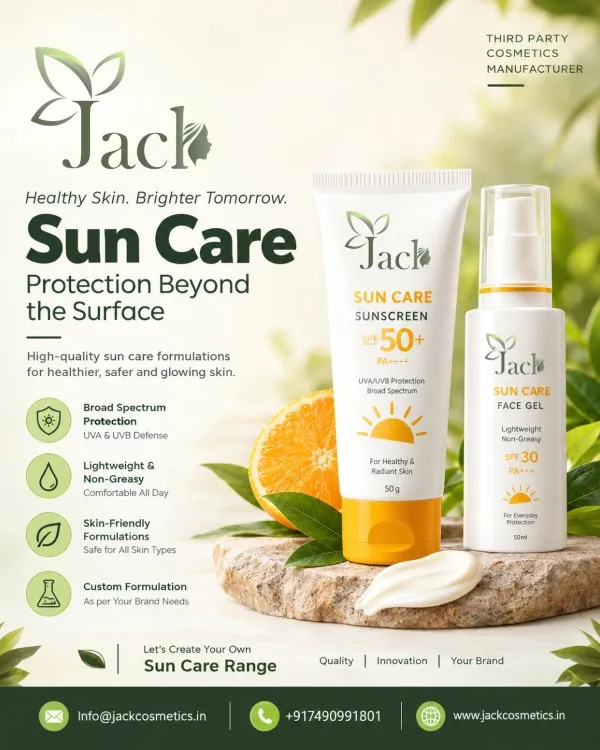
Jack Cosmetic Pvt. Ltd. has manufactured cosmetics since 2018. An experienced team with deep formulation expertise leads every project. The company has delivered custom solutions to 200+ brands with 98% client satisfaction and high repeat business.
What sets us apart:
- Certifications: ISO Certified, GMP Certified, FDA approved (wherever applicable), AYUSH (for Ayurvedic products)
- Values: Cruelty-free, eco-friendly and proudly Make in India
- Facility: State-of-the-art manufacturing unit with strict quality control
- Flexibility: Custom formulation, low MOQ and scalable production
- Service: On-time delivery, pan-India supply and full regulatory support
Our location: Survey no.324 paiki Plot no. 10/A, Near Paradise Industrial Park, Village – Chachrawadi Vasna, Sarkhej Bavla Road, Ta. Sanand, Dist. Ahmedabad, Gujarat – 382213, India.
Frequently Asked Questions
Q. What is a sunscreen manufacturer?
- It is a company that formulates, produces, tests and packs sun protection products for other brands. It offers services such as private label, OEM and contract manufacturing, so brands launch sunscreens without owning a factory.
Q. How does the sunscreen manufacturing process work?
- The process starts with formulation and ingredient sourcing. Next, the factory blends and emulsifies UV filters, tests the batch for quality and SPF performance, then fills, labels and ships the product. Each stage keeps SPF and texture consistent.
Q. What is the MOQ for private label sunscreen?
- MOQ depends on the formula, SPF level and packaging. Jack Cosmetic offers low MOQ, so startups can launch without heavy upfront stock. Share your requirements, and the team will confirm exact quantities.
Q. Which SPF should a new sunscreen brand launch with?
- Most dermatology guidance recommends broad-spectrum sunscreen with SPF 30 or higher. Brands commonly launch SPF 30 and SPF 50 options. Add a PA rating to show UVA protection.
Q. Can I sell private label sunscreen under my own brand in India?
- Yes. You can sell sunscreen under your own brand if the product and label meet Indian cosmetic regulations. Your manufacturer should supply formulation details, test reports and labelling guidance.
Q. How do I verify a sunscreen supplier’s quality?
Ask for GMP and ISO certificates, SPF and stability test reports and batch records. Request samples, check client references and inspect the facility in person or online.
Conclusion
The right partner gives your brand a safe formula, proven SPF and reliable delivery. Compare certifications, testing practices, MOQ and regulatory support before you decide.
Jack Cosmetic Pvt. Ltd. combines formulation expertise, GMP and ISO-certified production and low MOQ for growing brands. Ready to launch your sun care range?
Call: +91 74909 91801 | Email: Info@jackcosmetics.in
Get Quote