
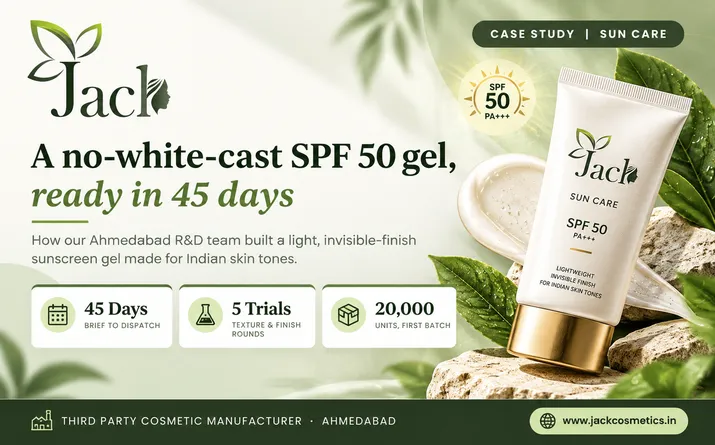
The Formulation Challenge
The founder, a practising dermatologist, kept hearing the same complaint from patients: sunscreens leave a grey-white layer on medium and deep skin tones, so people stop using them. The brief was a high-protection gel that feels like a moisturiser, sits well under makeup, and does not sting the eyes. It also had to stay stable in hot, humid weather, since most of the brand’s customers live in southern cities.
Jack Cosmetics Solution & Innovation
Sun care is unforgiving, so we began with the filter system. We chose a combination that gives broad protection without a chalky finish, then built a fresh, water-based gel around it. Five trial rounds focused only on finish and feel, and each one was checked on different skin tones, not just the lab bench. Once the texture was right, we arranged SPF and photostability testing so the label claim had real data behind it. Finally, we ran heat and humidity checks with the brand’s chosen tube to make sure the gel stayed smooth and did not separate.
Market Impact & Production Results
The brand launched on schedule with a gel that customers called light and invisible on the skin. Pharmacy partners reordered within the first quarter, and the founder now uses the product as a talking point during consultations. Based on this launch, the brand has asked us to develop a tinted version and a kids’ mineral sunscreen.
“Most sunscreens fail the moment a patient looks in the mirror. Jack Cosmetics understood that finish matters as much as protection. They kept us updated after every trial, and the final gel is the first one I feel comfortable recommending.”
A good sunscreen is only useful if people actually enjoy wearing it. This case study shows how our team in Sanand, Ahmedabad helped a dermatologist-founded brand create an SPF 50 gel that protects well and still dries clear on Indian skin tones.
Our process at a glance
- Week 1 to 2: Brief review, filter system selection and base gel design
- Week 3 to 4: Five finish and texture trials across different skin tones
- Week 5: SPF and photostability testing, plus heat and humidity checks
- Week 6 to 7: Final approval, tube filling and dispatch documentation
Key takeaways
- Finish is as important as SPF value when you want repeat buyers.
- Test on real skin tones early, not only in the lab.
- Always keep the test report ready before printing any SPF claim.
FAQs
1. How do you make a sunscreen gel without white cast?
- We choose a modern filter system and a lightweight gel base, then test several finish and texture rounds on different skin tones. This keeps the protection high while the gel dries clear on the skin.
2. Is SPF testing included in your sunscreen manufacturing process?
- Yes. We coordinate SPF and photostability testing so that any claim printed on your label is supported by a proper test report.
3. How long does sun care product development take?
- Most sun care projects take 5 to 7 weeks from brief to first batch, because filter selection and testing need extra time.
4. Can you manufacture sunscreen in tubes and other packaging formats?
- Yes. We check how the formula behaves with your chosen tube, bottle or pump, and we support filling and batch documentation.
Call to action
Planning a sun care launch? Share your brief with our formulation team and get a clear plan, timeline and quote. Contact Jack Cosmetics